
How to Search Beaufort County Court Records
Most Beaufort County court record searches start with the statewide NC eCourts Portal. The portal is used for public case information, court dates, citation searches, and eligible payments. North Carolina has moved all counties into Enterprise Justice and Odyssey, so Beaufort County public case lookup now follows the same broad statewide search path used across the Judicial Branch.
The portal is useful for name, case number, citation number, and county-based searches, but it is not the same as the official court file. Older paper documents, certified copies, divorce judgments, estate files, judgments, liens, foreclosures, evictions, partitions, and condemnation files still route through the Beaufort County Clerk of Superior Court. The clerk also remains the local point of contact when online case data is incomplete, restricted, or too thin for a certified copy request.
The official NC eCourts Portal is shown in the manifest image below.
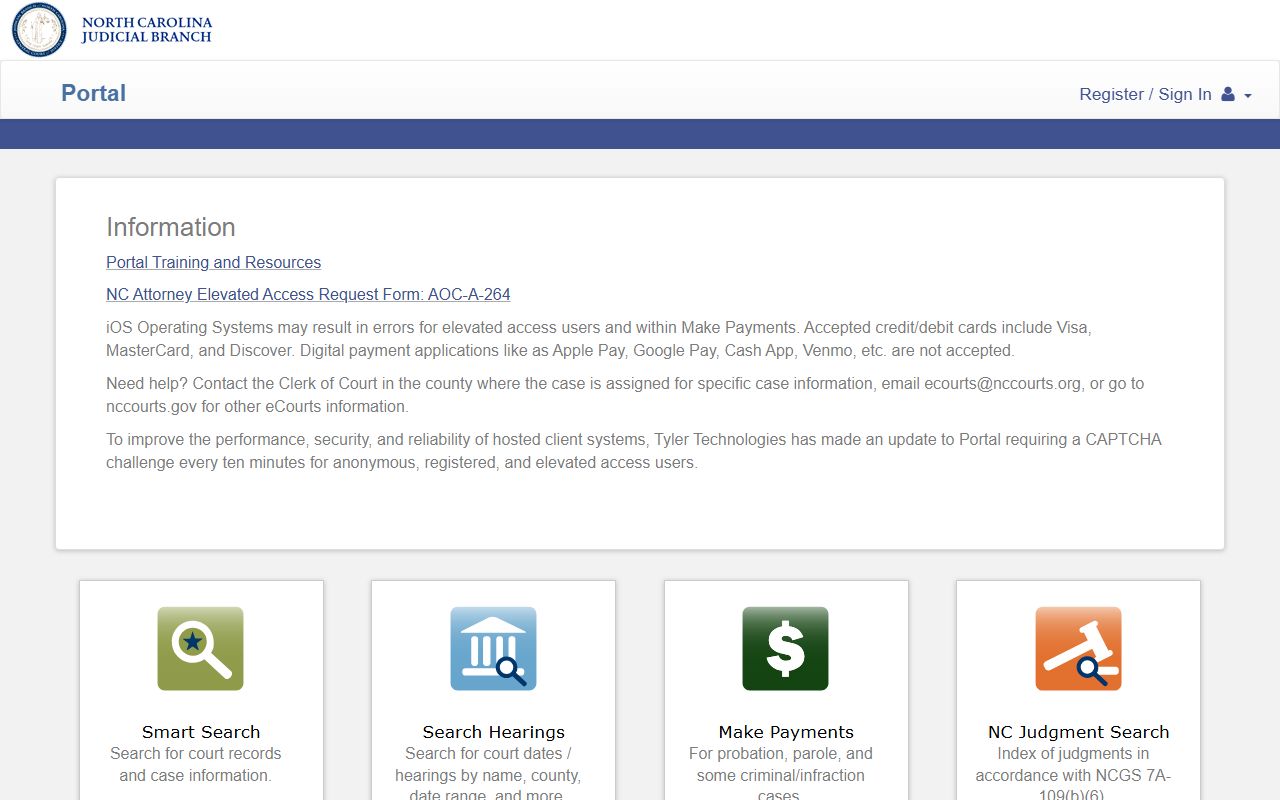
That portal image connects to the main online channel, but certified records and full file review still depend on the clerk when the public summary is not enough.
- Confirm that the matter belongs in Beaufort County, North Carolina, and not in another county or a federal court.
- Search the NC eCourts Portal by party name, case number, citation number, or county where the portal offers that field.
- Use the official court calendar system when the main need is a hearing date, session, or docket setting.
- Contact the Clerk of Superior Court when the file itself, an older paper record, or a certified copy is needed.
- Use the Register of Deeds instead when the record is a deed, marriage index, birth certificate, death certificate, or recorded land instrument.
Beaufort County Court System
Beaufort County is part of the North Carolina General Court of Justice. The county is listed in Prosecutorial District 2, Superior Court District 2, and District Court District 2. The main trial divisions are Superior Court and District Court. Superior Court handles felony criminal cases, major civil matters, civil jury matters, some appeals from District Court, and will caveat proceedings. District Court handles misdemeanors, infractions, traffic, small claims, juvenile matters, most domestic cases, and lower civil matters.
Magistrates are also part of the local court process. They handle initial appearances, criminal process functions, small claims-related duties, and some bond-related steps. The elected Clerk of Superior Court is the record keeper for both trial divisions and also acts as probate judge for estates and many special proceedings. That clerk role is one reason Beaufort County court records, estate files, and certified copies often point to the same courthouse office even though the underlying case types differ.
Case flow: Magistrate or District Court start › District Court disposition or Superior Court felony/civil track › North Carolina Court of Appeals › Supreme Court of North Carolina in selected matters.
| Court or Office | Role | Beaufort County Contact |
|---|---|---|
| Superior Court | Felonies, major civil cases, civil jury matters, will caveats, some appeals | Beaufort County Courthouse, Superior Court Judge (252) 940-4016 |
| District Court | Misdemeanors, infractions, traffic, small claims, juvenile, domestic, lower civil | Beaufort County Courthouse, District Court Judges (252) 940-4012 |
| Clerk of Superior Court | Court files, copies, payments, estates, special proceedings, probate duties | PO Box 1403, Washington, NC 27889, (252) 940-4000 |
| Magistrates | Initial appearances, criminal process, bond-related steps, small claims functions | Magistrates (252) 940-4019 |
The North Carolina Judicial Branch Beaufort County page displays the county's district assignments and links to local court services.
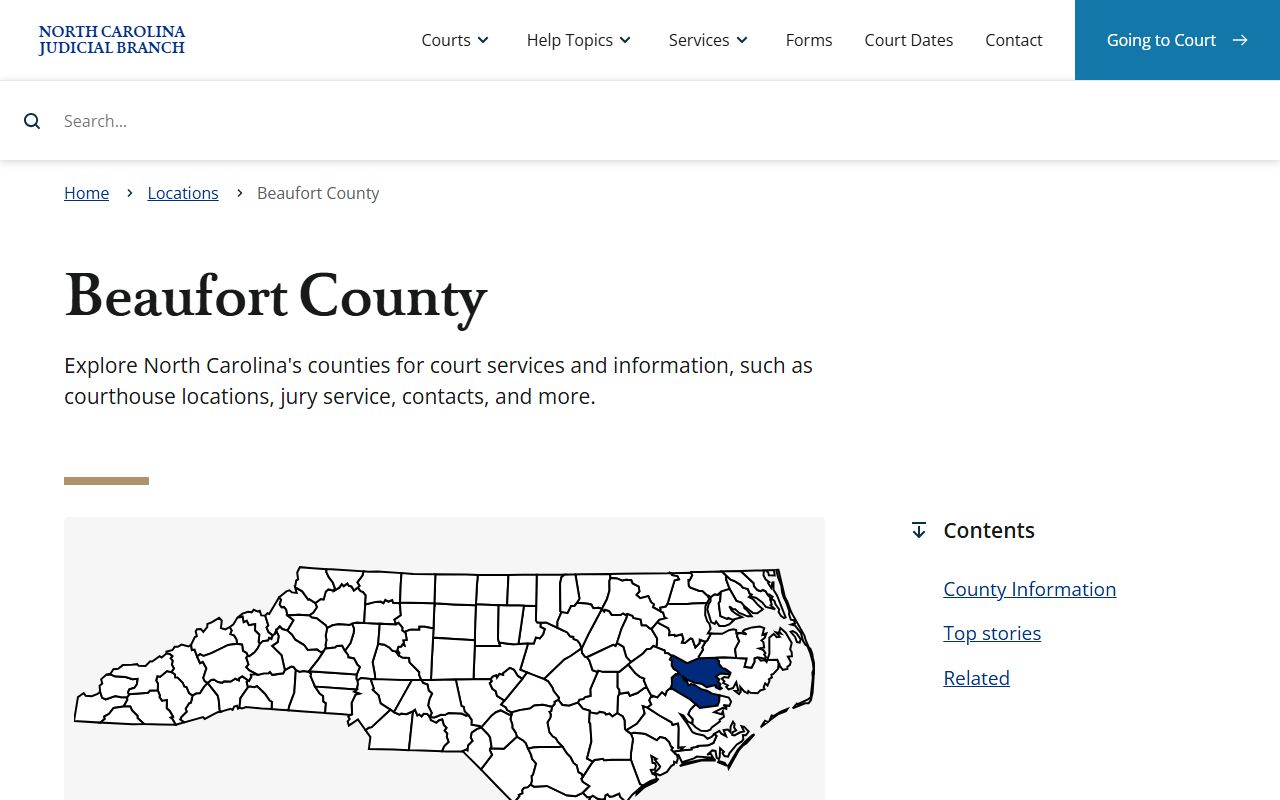
The county page is the best official launch point when the question is local court dates, payment information, courthouse service links, or Beaufort County court contacts.
Beaufort County Courthouse Contacts
The central courthouse is in Washington, North Carolina, and houses the Clerk of Superior Court, Superior Court and District Court functions, magistrate access, cashier services, court records, jury service, local rules, and related Judicial Branch services. The same courthouse block is also important for detention questions because the Beaufort County Detention Center is described by the sheriff as an 85-bed direct-supervision facility in the courthouse basement.
The county has related offices nearby. The District Attorney for Prosecutorial District 2 lists a Beaufort office on West Second Street, while Public Defender District 2 is on North Respess Street. The Register of Deeds is separate from the Clerk of Superior Court, even though both offices work with public records. Register of Deeds records include marriage records, vital record copies, deeds, and real estate instruments.
The official Beaufort County Courthouse page provides the courthouse address, hours, and location details.
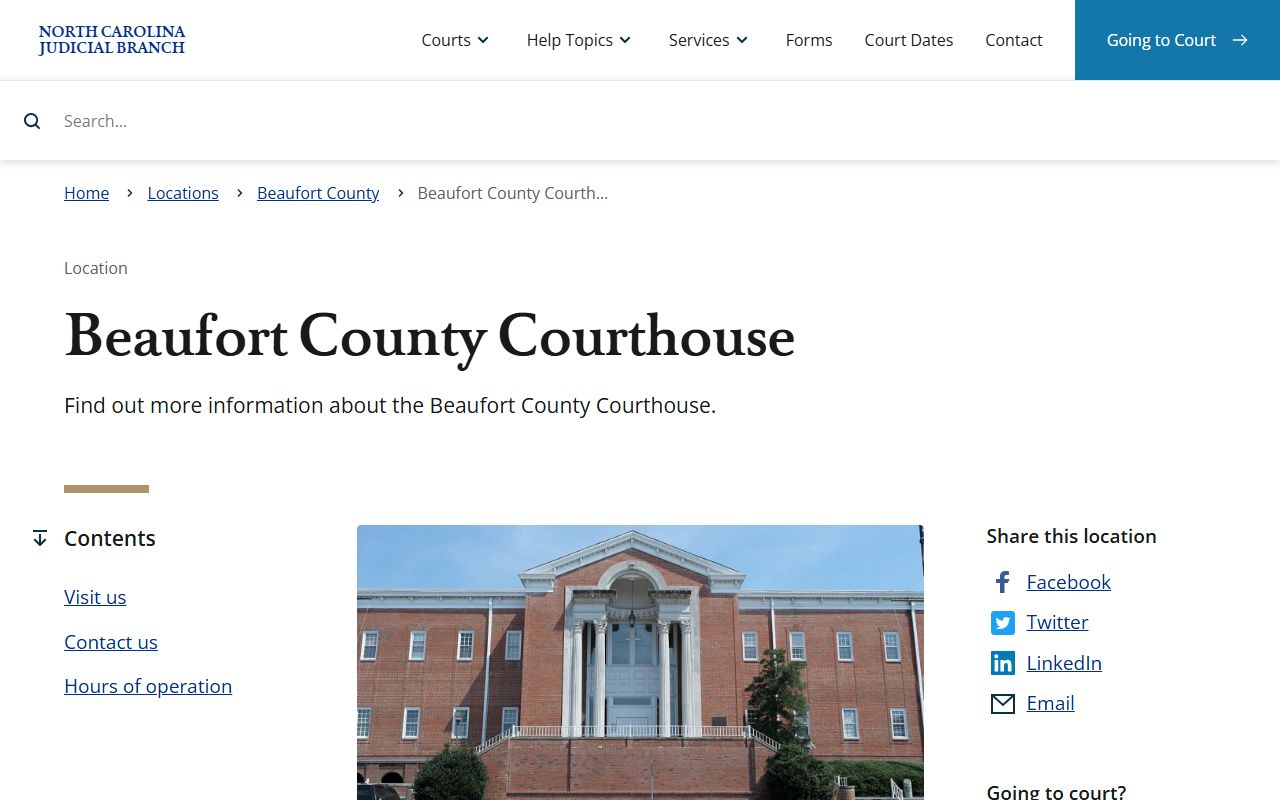
That courthouse source supports the address and visitor information used for clerk, payment, court-date, and in-person record access.
Beaufort County Courthouse
112 W Second St
Washington, NC 27889
(252) 940-4000
Monday-Friday, 8:00 AM-5:00 PM
Beaufort County Sheriff's Office
210 N Market Street
Washington, NC 27889
(252) 946-7111
24-hour detention contact
Register of Deeds
112 W 2nd Street
Washington, NC 27889
(252) 946-2323
Marriage and vital record office
Beaufort County Court Record Types
Beaufort County court records include civil, criminal, family, probate, special proceeding, traffic, and infraction records. Civil files may include complaints, answers, motions, orders, judgments, liens, foreclosures, evictions, partitions, and condemnations. Criminal files may include charges, initiating process, appearances, bond entries, pleas, dispositions, sentencing, fines, costs, probation terms, and compliance events.
Family and domestic court records can include absolute divorce, custody, visitation, support, equitable distribution, domestic violence protective orders, and related motions. Probate and estate records are handled through the Clerk of Superior Court acting as probate judge. Traffic files are court cases tied to citations and infractions, while the state driver record is a separate file held by NCDMV. Juvenile records, adoptions, sealed matters, expunged records, and some mental health or protective-order material are not open in the same way as ordinary civil or criminal files.
- Civil records cover lawsuits, judgments, liens, foreclosures, evictions, partitions, and condemnation matters.
- Criminal records show filed charges, hearings, pleas, dispositions, sentences, fines, and bond-related events.
- Family records include divorce and domestic filings, but adoption and juvenile records are restricted.
- Estate records include filed wills, applications, inventories, letters, accountings, claims, and clerk orders.
- Traffic records track citations, court dates, waiver/payment eligibility, dispositions, costs, and compliance events.
What Beaufort County Court Records Show
A public case result is best read as a summary of the court file. It may show the case number, county, court division, case type, parties, attorneys, filing date, events, hearings, financial data, status, and disposition. Criminal and traffic matters may also show offense data, bond, court costs, payment eligibility, and compliance events. Civil records may show claims, judgments, liens, service returns, notices, and orders.
Public online data is useful, but not every document image is available through the portal. Some records require an account or clerk inspection. Some items are restricted by law. Personal identifiers, juvenile identities, adoption records, sealed records, expunged matters, and protected financial details should not be expected in a public online view. The official file remains with the Clerk of Superior Court for court cases located in Beaufort County.
| Field | What It Shows |
|---|---|
| Case Number | The public file number used for portal searches, clerk requests, and calendar checks. |
| Filing Date | The date the initiating document or case opening was entered. |
| Parties | Plaintiff and defendant, State and defendant, petitioner and respondent, or estate parties. |
| Charge or Cause | The alleged offense, civil claim, estate matter, or special proceeding description. |
| Docket Events | Hearings, filings, motions, orders, continuances, judgments, pleas, and disposition entries. |
| Financial Data | Costs, fines, restitution, payment status, civil judgment sums, or bond entries where public. |
The Beaufort County court contact directory lists local court offices used when a case field needs confirmation.
The contact directory matters because a case field may point to the clerk, District Attorney, magistrates, court reporters, custody mediator, or Guardian ad Litem office.
Beaufort County Public Access Laws
North Carolina public access starts with a broad public-records law, but court files also follow Judicial Branch rules and case-type restrictions. G.S. 132-1 defines public records made or received in public business. Court case access then depends on the type of file, the court division, whether the file is sealed or confidential, and whether the record is a case file, an administrative record, or a county-office record.
The Judicial Branch public-record request path is not a shortcut for every court file. It routes requests to the right custodian. Court case information usually goes through Portal or the Clerk of Superior Court. Deeds, marriage records, and many vital records go through the Register of Deeds. Police reports go to law enforcement. Statewide criminal and civil data subscriptions are handled through Remote Public Access, which is separate from one-time public lookup.
The official Judicial Branch public record request service explains this routing.
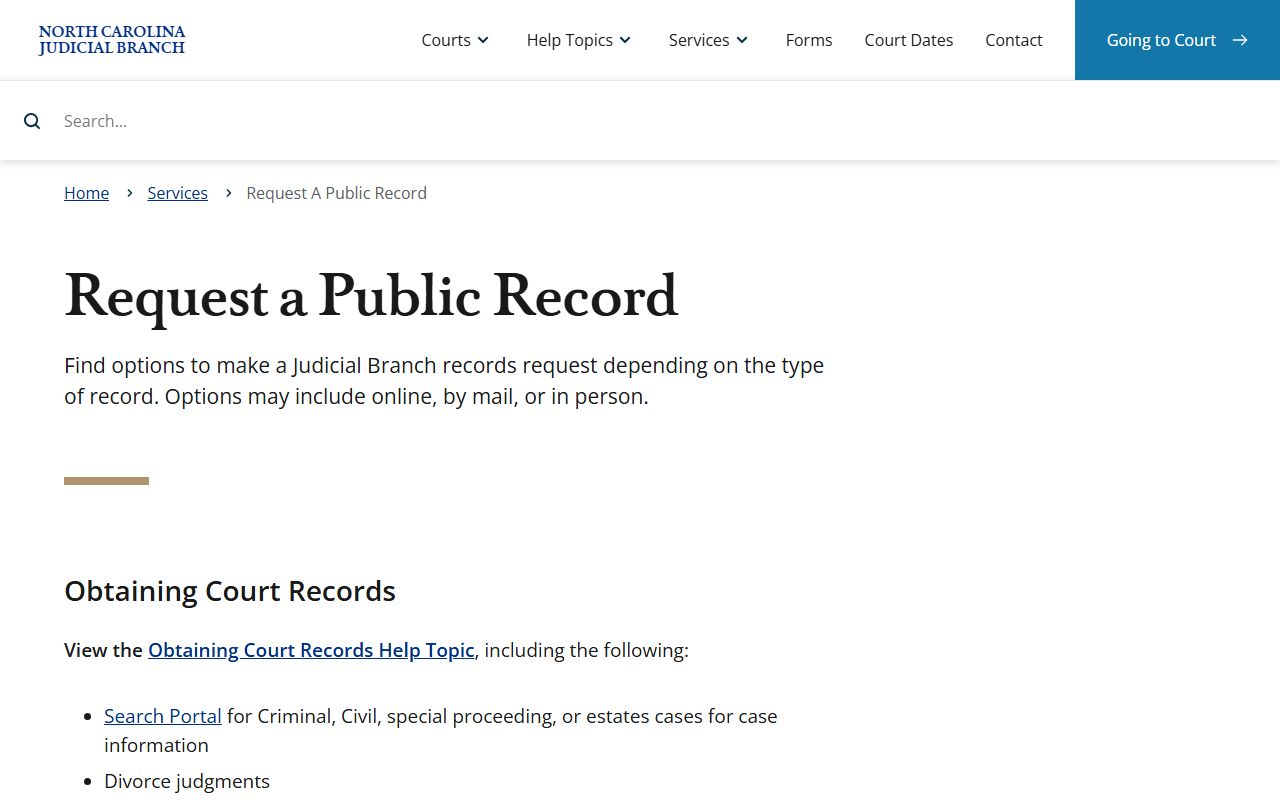
That request source is most useful when the question is which office holds the record, not when the user already needs a specific Beaufort County case file.
Key Statutes:
G.S. 132-1 defines public records in North Carolina.
G.S. 132-1.10(g) allows written requests to remove specified identifying numbers from online official-record images.
G.S. 7B-3000 makes juvenile court record information confidential.
G.S. 15A-145.5 governs expunction of certain nonviolent misdemeanor and felony convictions.
Restricted Beaufort County Records
Some Beaufort County records are not ordinary public records. Juvenile delinquency records are confidential under North Carolina law. Adoption files are restricted. Sealed and expunged records should not appear in ordinary public searches. Mental health proceedings, incompetency matters, guardianship medical details, protective-order filings, victim safety information, and personal identifiers may be limited, redacted, or available only to authorized parties.
Expunction is a court process, not a website correction. A petitioner must identify the Beaufort County case number, charge, disposition, and conviction or dismissal outcome, then use the correct AOC form for the statutory basis. For certain nonviolent misdemeanor and felony convictions, the research identifies AOC-CR-281 under G.S. 15A-145.5. The filing occurs with the Clerk of Superior Court in the county of conviction, and the district attorney and court review may be required.
Note: A missing public portal result does not prove that no record exists, because sealed, older, restricted, and paper files may follow different access paths.
Beaufort County Court Programs
Beaufort County's official Judicial Branch page lists court programs rather than separate local specialty-court pages. Programs shown for Beaufort County include Clerk Mediation Program, Family Financial Settlement Program, Juvenile Court Improvement Program, Guardian ad Litem, and Child Custody and Visitation Mediation Program. These programs are not separate courts, but they affect how certain civil, family, juvenile, and clerk-related matters may move through the courthouse.
The Child Custody and Visitation Mediation Program has a local contact number in the Beaufort County directory, and Guardian ad Litem also has a local number. Those contacts are useful for family and juvenile-related court users, but juvenile and child welfare records remain sensitive. Family financial settlement and clerk mediation can affect the practical path of a case without changing which court holds the file.
Beaufort County Sheriff and Jail
The Beaufort County Sheriff's Office is separate from the Clerk of Superior Court, but sheriff records and jail information often connect to court cases. The sheriff's current detention pages state that inmate search and bail bonding are app-only through the Beaufort County NC Sheriff app. No ordinary browser jail roster was found on the official sheriff website. For jail status, the official channel is the app or the 24-hour sheriff/detention phone line.
The detention center opened in 1969 and is described as an 85-bed direct-supervision facility in the basement of the Beaufort County Courthouse. It houses pretrial detainees charged with felony and misdemeanor offenses and people serving shorter confinement terms. The sheriff homepage also publishes local performance statistics, including criminal processes served, 911 calls, school checks, investigations cleared, and fentanyl seizure data for the Apr 2025-Mar 2026 reporting period.
The sheriff app matters for custody searches. The inmate page gives the full app-only lookup detail for Beaufort County inmate records.
Beaufort Marriage Divorce Probate
Marriage records and licenses are handled by the Beaufort County Register of Deeds, not by the Clerk of Superior Court. Register of Deeds Carolyn L. Garris is the official listed for that office in the research. The office handles vital record access, marriage license requirements, online marriage application intake, online services for indexes, and certified vital record ordering. The online marriage application does not issue the license by itself; both applicants still must appear with required proof.
Divorce judgments are court records at the Clerk of Superior Court in the county where the divorce was granted. Divorce certificates from 1958 to present may be available from NC Vital Records, but NC Vital Records warns that vital records are not free public records. Probate is also a clerk function in North Carolina because the Clerk of Superior Court acts as ex officio judge of probate for estates, many guardianship matters, and special proceedings.
- Testator
- The person who made a will.
- Executor
- The person named to carry out a will after appointment by the clerk.
- Intestate
- A death without a valid will controlling estate distribution.
- Caveat
- A formal challenge to a will's validity, heard by a Superior Court judge in North Carolina.
Beaufort County Court Records Fees
Court costs and copy charges depend on the type of file and the current Judicial Branch cost schedule. The research confirms that clerks must charge for photocopies and miscellaneous services, and that current statewide cost publications cover civil, criminal, estates, and special proceedings fees. The estate guide gives one specific figure: a $120 filing fee to begin formal estate administration.
Payment rules are more specific for Beaufort County. By mail, payments must be made by money order or certified check payable to Beaufort County Clerk of Superior Court. No cash or personal checks are accepted by mail. In person, the Cashier's Office accepts cash, credit or debit card with processing fees, money order, and certified check, but no personal checks. Online payments use credit or debit cards with processing fees when the case is eligible.
The official Beaufort County payment information page provides the local payment rules.
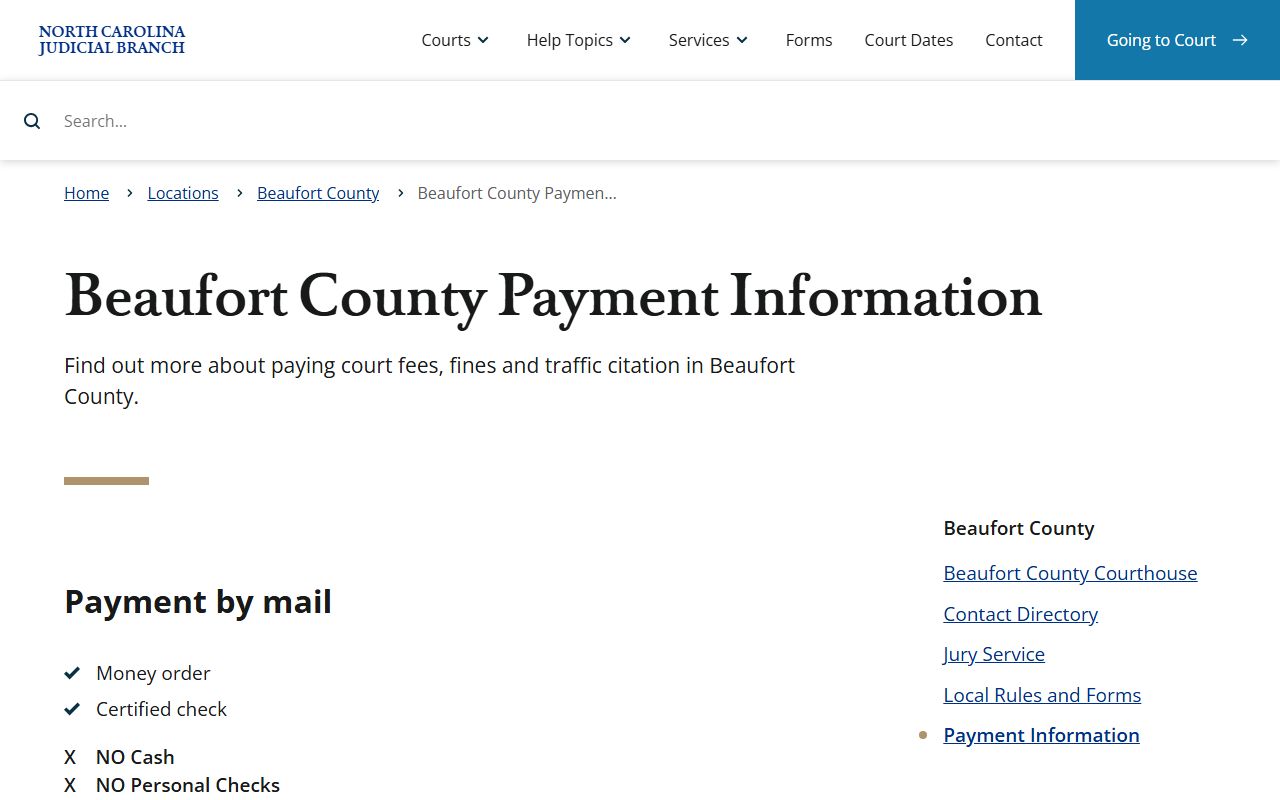
The payment source is especially important for traffic citations because mail payments must include the citation number when payment by mail is allowed.
| Item | Amount or Rule |
|---|---|
| Court record copies | Fee required under current court cost schedules. |
| Certified or exemplified copies | Fee required; verify current amount with clerk or current cost publication. |
| Formal estate administration filing | $120 filing fee listed in the Judicial Branch estates guide. |
| Mail payment | Money order or certified check only; no cash and no personal checks. |
| In-person payment | Cash, card with processing fees, money order, or certified check; no personal checks. |
Beaufort County Court Dates
Court calendars are separate from full case files. A calendar lookup can show the date, session, county, case setting, and sometimes judge or courtroom information, but it does not replace the clerk's file. Beaufort County's official court page links civil and criminal calendars, and those calendars should be used when the immediate question is when to appear or whether a matter is on a docket.
The statewide North Carolina court calendars page is shown below.
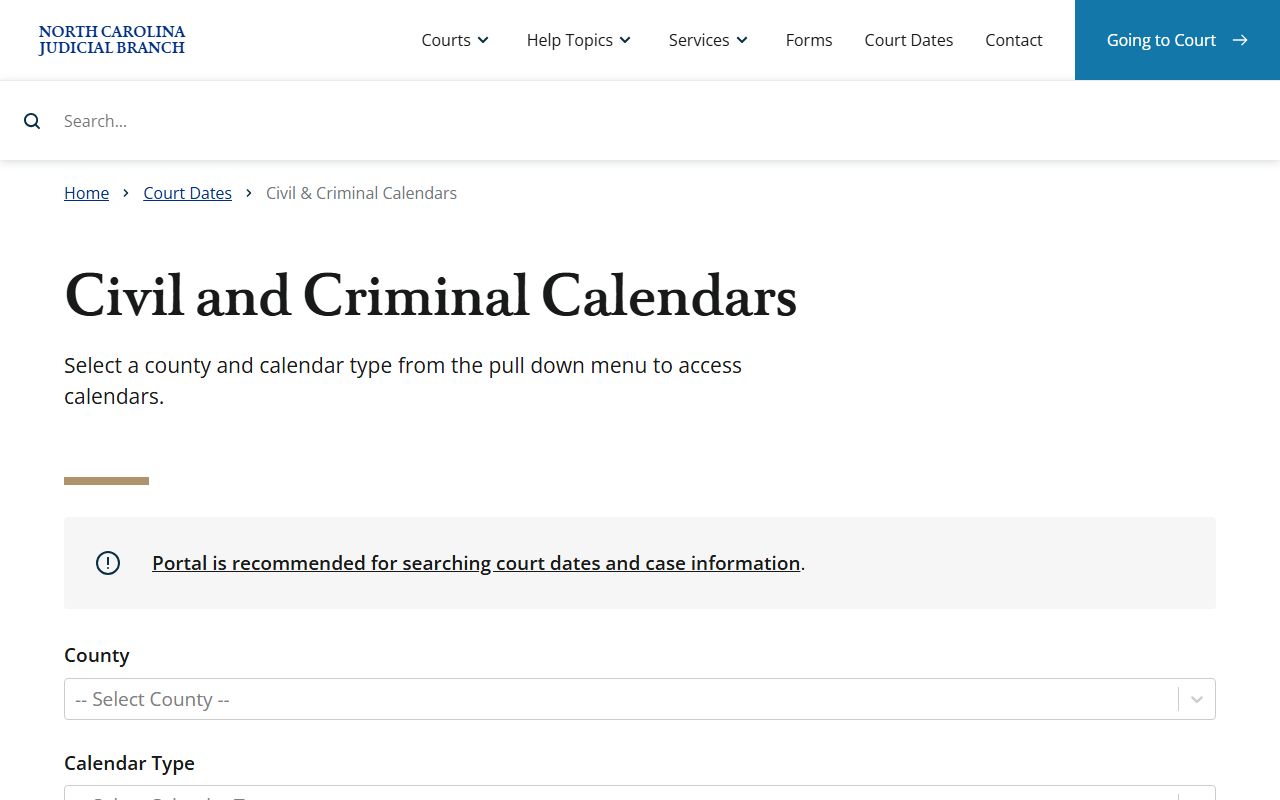
Calendar results can change after continuances, notices, or administrative updates, so a party should confirm uncertain dates with the court file or clerk.
The Judicial Branch online services page also links Portal, File & Serve, Guide & File, payment services, interpreter requests, disability accommodation, and public-record services.
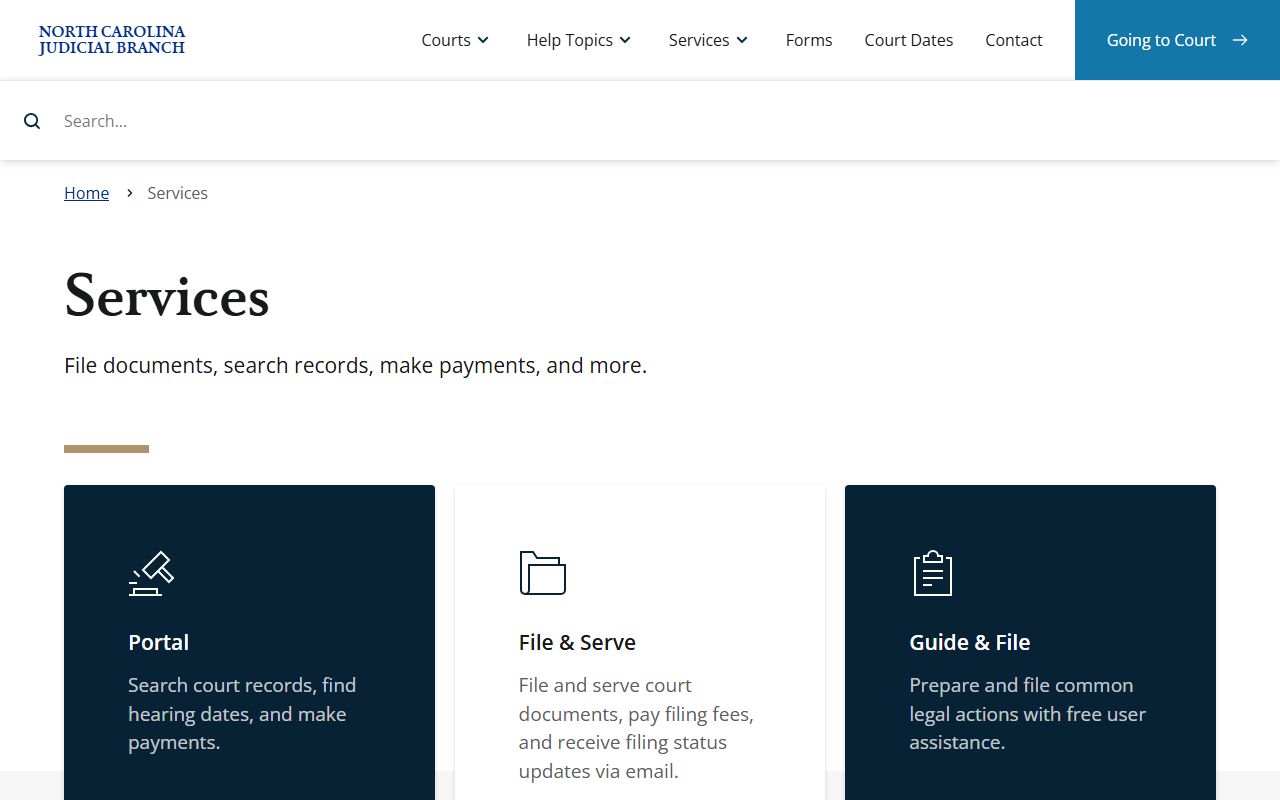
Those service links help separate case lookup, electronic filing, guided form preparation, payment, and public-record routing into the right official channel.
Interpret Beaufort County Records
Beaufort County court records use terms that can look simple but mean different things. A charge is an accusation, not proof of guilt. A conviction is a guilty finding or plea accepted by the court. A disposition is the final outcome of a charge or case. A dismissal ends a charge or claim without a conviction or judgment against that party. A judgment is the court's final decision imposing relief, sentence, costs, or another obligation.
Criminal records should be read by stage. An arrest or citation can lead to a filed charge. The District Attorney decides how the State proceeds. The case then moves through appearances, motions, plea or trial, disposition, and sentencing if there is a conviction. In civil and estate files, party labels change. Plaintiff, defendant, petitioner, respondent, decedent, personal representative, creditor, and debtor each point to the person's role in that file.
Accuracy and Record Limits
Online court records can lag behind courtroom events, clerk processing, payment posting, or agency updates. Portal results also may not show full document images. If a case has a missing document, unclear disposition, older paper file, sealed status, or certified-copy need, the Clerk of Superior Court is the better access point. For traffic matters, the court case and the NCDMV driver record are separate files, so one system may update before the other.
Recent local alerts also matter. The sheriff warned in June 2026 about scam calls claiming missed jury duty and demanding payment to avoid arrest. Legitimate court officials and law enforcement do not demand gift cards, prepaid cards, cryptocurrency, or payment apps for jury-duty fines. Beaufort County jury excusal, postponement, or deferment requests may be mailed to the Jury Clerk or submitted electronically, and electronic requests must be made at least six days before the appearance date.
Note: Verify court dates, payments, warrants, and certified-copy needs with the originating official office before acting on online-only information.
Beaufort County Court History
Current official sources place Beaufort County's court identity in Washington and within the statewide Judicial Branch district system. The county is part of Prosecutorial District 2, Superior Court District 2, and District Court District 2. The most useful modern records-history fact is the statewide eCourts conversion, which changed how Beaufort County case access, filing, and payments operate.
North Carolina completed eCourts implementation in all 100 counties on October 13, 2025. The state reports that all counties now use Enterprise Justice and Odyssey. That matters for Beaufort County because Portal, File & Serve, Guide & File, and related online services now shape public access to many court functions. Older courthouse construction details, architects, fires, and renovations were not confirmed in the official sources reviewed, so those claims should not be added without separate official research.
The statewide North Carolina eCourts information page documents the eCourts program.
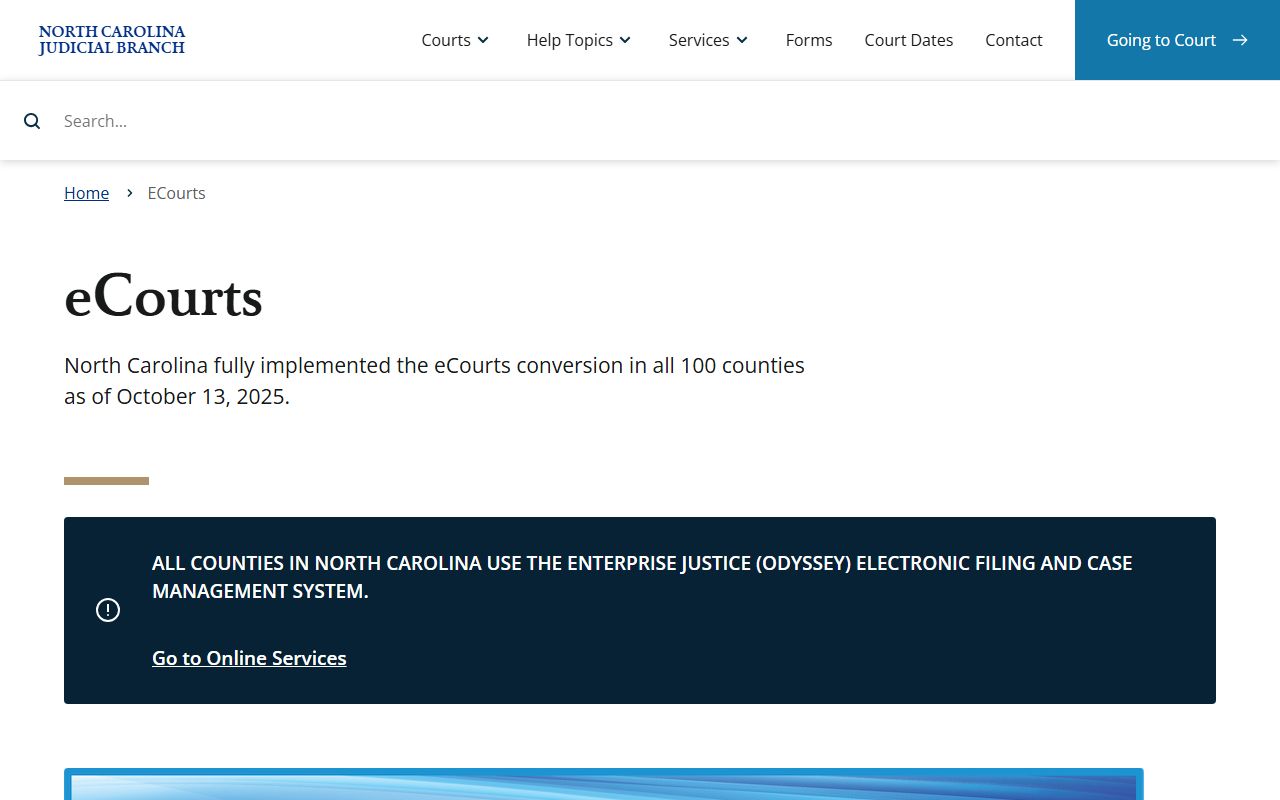
The eCourts change is the key records-access history point because it affects present-day searching, filing, calendars, and payments.
Beaufort County Court FAQ
Where do Beaufort County court records start?
Start with the NC eCourts Portal for public case information, court dates, citation lookup, and eligible payments. If the file itself, an older document, a certified copy, or a divorce judgment is needed, contact the Beaufort County Clerk of Superior Court.
Does Beaufort County have a separate probate court?
No separate probate courthouse was identified in the research. In North Carolina, the Clerk of Superior Court acts as ex officio judge of probate. Estate administration, filed wills, letters, inventories, and many special proceedings route through the clerk.
Is there a public Beaufort County warrant list?
No official public browser-based active warrant list was found. Warrant-related questions should use the proper fallback chain: NC eCourts for filed cases, the Clerk of Superior Court, magistrates, the sheriff, or an attorney. Crime Stoppers is for tips, not personal warrant clearance.
How is a traffic case different from a driver record?
The court traffic case is kept by the court system and may show citation, charge, court date, disposition, costs, and payment eligibility. The NCDMV driver record is a separate state driving-history file with license status and recorded convictions.
Where are marriage records kept?
Marriage licenses and marriage record access are handled by the Beaufort County Register of Deeds. Divorce judgments are court records held by the Clerk of Superior Court in the county where the divorce was granted.