
Beaufort County Arrest Records and Court Charges
Arrest records start with law enforcement. They may identify the person arrested, arresting agency, booking or custody status, arrest date, alleged offense, bond information, and jail-related details when public. In Beaufort County, the sheriff operates the detention center and court security functions, while the court charge record is maintained through the court system after charges are filed. The sheriff's website does not provide an ordinary browser jail roster; the research file states that inmate search and bail bonding are app-only features of the Beaufort County NC Sheriff app.
Court charges after arrest are the filed accusations and case entries tied to the arrest. They are not the same as an arrest report, a mugshot page, or the final criminal case file. A charge record may show alleged offense, statute, offense date, arrest or charge date, case number, court division, bond, next court date, and disposition once resolved. For jail custody, use the county inmate channels. For the full prosecution history, use the Beaufort County criminal court records page and the clerk's official file.
The Beaufort County Sheriff's Office homepage identifies Sheriff Scott Hammonds and the local law enforcement office tied to arrests, court security, jail, and criminal process service.
The sheriff source helps locate arrest and jail channels, but filed court charges must still be checked through court systems or the Clerk of Superior Court.
How to Find Beaufort County Arrest Records and Charges
Use a two-track search because arrest and court charging data live with different custodians. For jail custody, the sheriff's official materials point users to app-only inmate search and app-only bail bonding. For charges filed in court, use NC eCourts Portal by defendant name, case number, citation number, and Beaufort County where supported. For complete records or certified copies, contact the Clerk of Superior Court at the courthouse in Washington.
- Check whether the question is about current custody, arrest details, or filed court charges.
- For custody or booking, use the Beaufort County NC Sheriff app channels or call the sheriff/detention contact at (252) 946-7111.
- For filed charges, search NC eCourts Portal by defendant name, case number, citation number, and Beaufort County.
- Open the case and read each charge, statute, degree or level, bond, hearing date, and status separately.
- Use the Clerk of Superior Court for certified copies, older paper files, complete documents, and official case-file inspection.
- Use the District Attorney or defense counsel for prosecution or representation questions, not for public record copies.
Beaufort County's detention center is tied to the sheriff, while court charges are tied to the State's prosecution and the clerk's record. That division prevents a common mistake: assuming a booking entry is the final criminal case result.
Charging Documents After Arrest
North Carolina criminal process includes warrants, criminal summonses, citations, orders for arrest, and related electronic repository rules. After an arrest or citation, the case record may show how the accusation entered court and whether later prosecution changed the charge. Felony prosecution may involve indictment in Superior Court. Misdemeanors and infractions usually remain in District Court unless another procedural path applies.
| Charging Document / Process | Common Use | What to Check in the Record |
|---|---|---|
| Citation | Traffic infractions and some lower-level offenses. | Citation number, offense, county, court date, waiver or payment eligibility. |
| Warrant | Criminal process issued on probable cause for arrest. | Charge, issue date, served date, bond, case number, next court date. |
| Order for Arrest | Often tied to failure to appear, violation, or other statutory ground. | Reason issued, recall or served status, bond, related case event. |
| Criminal Summons | Directs appearance without immediate custody in some cases. | Service status, court date, charge, and defendant information. |
| Indictment | Grand jury accusation supporting felony prosecution in Superior Court. | Indicted offense, file number, arraignment, motions, plea, trial, or disposition. |
The manifest source for criminal process is North Carolina Chapter 15A Article 17.
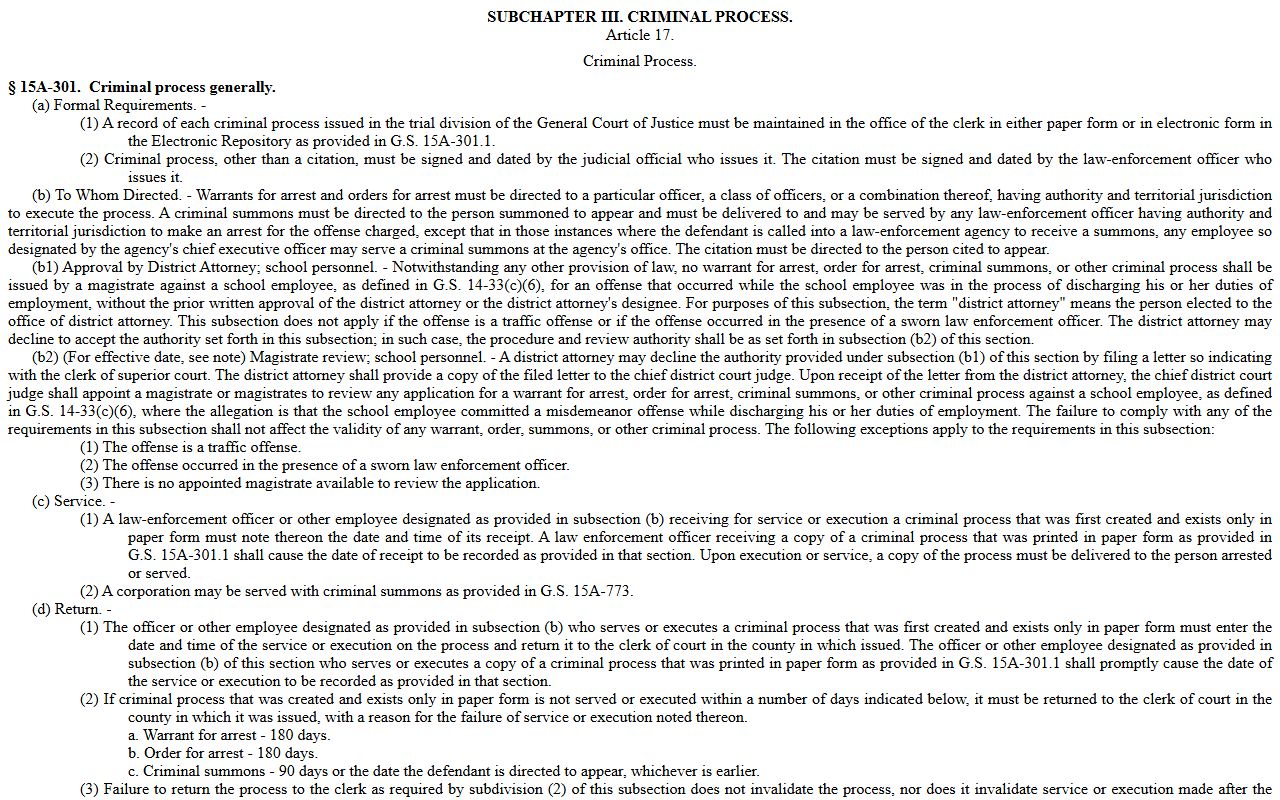
That statute article is the legal framework for understanding why arrest, summons, citation, warrant, and indictment are related but not identical record events.
Charge Status and What It Means
A court charge can change after filing. The District Attorney may proceed, dismiss, amend, reduce, or supersede a charge. A defendant may plead guilty to one charge while another is dismissed. A felony may start with initial process and later appear differently after indictment. Always read the current status and disposition for each separate count rather than treating the arrest label as the final case outcome.
| Status | What It Means |
|---|---|
| Pending | The charge remains open and awaits hearing, plea, trial, dismissal, or another court action. |
| Amended / Reduced | The filed accusation changed, often to a different offense level or statutory description. |
| Dismissed | The court record shows the charge was terminated without conviction on that count. |
| Superseded | A later charging document, often an indictment, replaced or reframed the earlier charge. |
| Disposed | The court has entered an outcome, which must be read together with plea, judgment, or sentence fields. |
| Failure to Appear / Order for Arrest Event | The case has a missed-court or process event that may affect bond, license, or next court date. |
Arrest Authority and Orders for Arrest
North Carolina law distinguishes arrest authority from the court's later case record. G.S. 15A-401 describes officer authority to arrest pursuant to a warrant or with knowledge that a warrant exists, along with other statutory arrest circumstances. G.S. 15A-305 lists circumstances when an order for arrest may be issued, including certain failures to appear. These statutes explain why a person may have both an arrest event and a later court record event tied to the same underlying case.
The source for officer arrest authority is G.S. 15A-401.
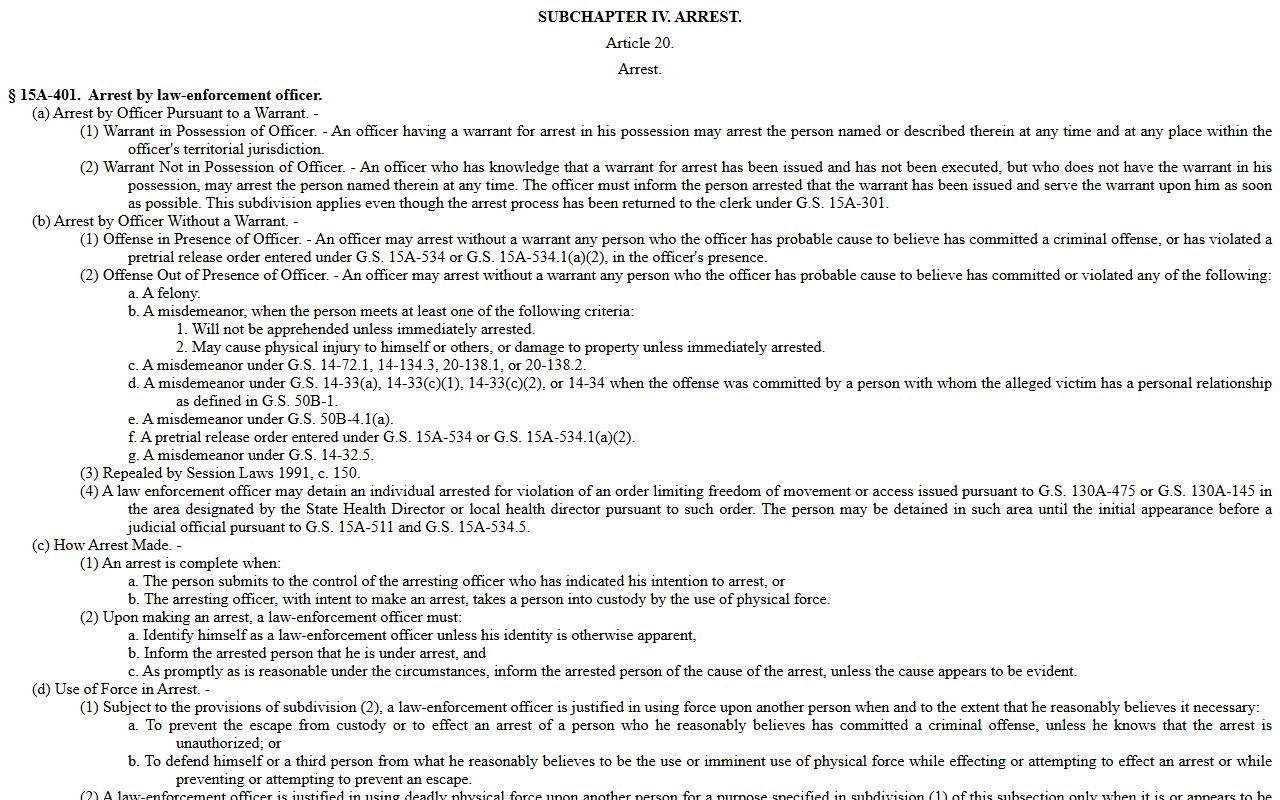
That statute supports the arrest-record side of the page, but it does not replace the need to inspect the filed court case.
The source for orders for arrest is G.S. 15A-305.
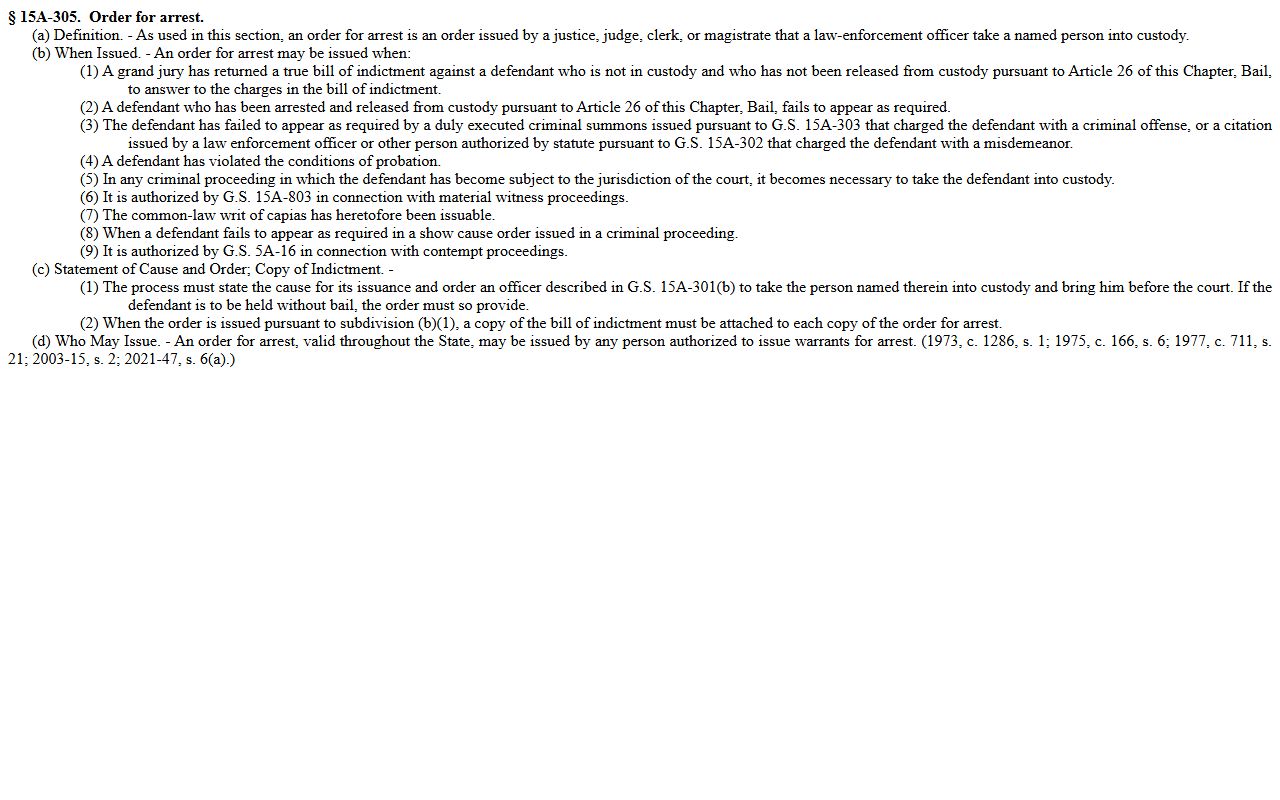
An order for arrest may appear as a process or docket event, so check both court status and law enforcement instructions before acting on old information.
Charge vs Conviction Comparison
Arrest records and charge records can be public before guilt is decided. A charge means the State has accused a person of an offense. A conviction means the court accepted a guilty plea or entered a guilty finding. Many searches return both unresolved accusations and final outcomes, so the disposition and sentence fields control the practical meaning of the result.
| Charge | Conviction | |
|---|---|---|
| Stage | Filed accusation after arrest, citation, warrant, summons, or indictment. | Final guilty result by plea or finding. |
| Proof Standard | Probable cause or charging decision, depending on process. | Beyond reasonable doubt at trial or a valid guilty plea. |
| Can Change? | Yes. It may be amended, reduced, dismissed, or superseded. | Can be appealed, corrected, or later expunged only if law allows. |
| Record Meaning | Shows what was alleged and tracked in court. | Shows criminal liability and judgment on that count. |
DA Review and Defense Counsel
The District Attorney decides prosecution of state criminal charges after law enforcement action. Beaufort County belongs to Prosecutorial District 2 with Hyde, Martin, Tyrrell, and Washington counties. Official sources identify Tom Anglim as District Attorney for Prosecutorial District 2. The Beaufort court contact directory lists the District Attorney phone as (252) 940-4010, and official listings place the Beaufort office at 111 W Second Street or PO Drawer 1705, Washington, NC 27889.
The Public Defender is not a records office. NCIDS lists Defender District 2 and Public Defender Laura Gibson, with the office at 227 N Respess Street, Washington, NC 27889, phone (252) 940-4014. Defendants should use counsel or court notices for legal strategy and appearance obligations. Victims and witnesses should use District Attorney channels. Public records, copies, and case-file inspection still run through Portal and the Clerk of Superior Court.
Sealed vs Expunged Arrest and Charge Records
Some arrest-related or charge-related information may stop being visible to the public. Sealed records are closed from ordinary public inspection by law or court order. Expunged records are removed from public view through statutory legal relief. North Carolina expunction under G.S. 15A-145.5 can apply to certain nonviolent misdemeanor and felony convictions when eligibility rules are met, and other statutes may address dismissed charges, not-guilty outcomes, age-based first offenses, or drug-related categories.
| Sealed | Expunged | |
|---|---|---|
| Public Visibility | Not open to ordinary public search. | Removed from ordinary public access after court order. |
| Common Categories | Juvenile, adoption, mental health, protected victim data, and court-sealed cases. | Eligible dismissals, not-guilty outcomes, first offenses, or qualifying convictions. |
| Process | Access usually requires statutory authority or court order. | Petition in the county of conviction or case, using the correct AOC form and procedure. |
| Practical Warning | Do not expect sealed records in Portal. | Do not treat a missing result as proof that an expunction occurred. |
Restricted Charge Records in Beaufort County
Juvenile delinquency records are confidential under G.S. 7B-3000 and are not ordinary public criminal records. Adoption records, some mental health and guardianship material, protected addresses, victim-sensitive filings, sealed warrants, unserved process, and active-investigation search warrant material may be unavailable or redacted. Court images and public files should also exclude Social Security numbers, bank account numbers, and other sensitive personal identifiers when redaction rules apply.
For practical research, collect the defendant name, case number, charge, offense date, court division, and disposition date before requesting a record. If the matter relates to current custody, confirm through sheriff or detention channels. If it relates to filed charges, confirm through Portal and the clerk. If it relates to legal advice, prosecution, or defense, use the District Attorney, public defender, appointed counsel, or private counsel as appropriate.
Background Check Considerations
Arrest records and court charges can be misunderstood in screening contexts. A name match may be wrong. An arrest may not have produced a conviction. A charge may have been dismissed. A conviction may later have been expunged. A public website result may omit restricted details or older paper records. For employment, tenant, credit, insurance, or any FCRA-regulated use, use a compliant background-check process rather than a casual public search.
Important: Arrest and charge lookup is not a consumer report and should not be used for FCRA-regulated decisions.